A Laptop in the Hands of Every Student


Before personal devices were part of the curriculum, LFHS owned a series of Chromebook carts that allowed students to check computers out in school. Despite this, access was often unreliable and depended heavily on the ability of teachers to reserve a cart for the day. This made it difficult to plan lessons or for students to work on online assignments outside of class.
When it came to homework, it became apparent that relying on students to have devices at their disposal was not an effective plan. Advocates for one-to-one argued that equal access to technology was crucial for a fair education.
“Some students had easier access to technology at home than others, which was pretty inequitable,” said Educational Technologist Mrs. Laura Grigg.
The inconsistency among students’ ability to access technology outside of school wasn’t the only driving force behind the decision. An increasingly digital world also meant that educational standards had begun to shift to include online programs. For some students, computer availability became the differentiating factor between an education tailored to their needs and an education that overlooked learning challenges.
“It mattered a great deal to students who had accommodations where they relied on technology, and the school was required to provide devices for them,” said Mrs. Grigg.
The Individuals with Disabilities Education Act (IDEA) has required IEP plans to consider assistive technology (AT)—laptops, tablets, special software—for every student with an educational disability since 1997. This was backed by the Illinois State Board of Education who further implemented that AT must be maintained and provided by the school district.
Going one-to-one with Chromebooks in 2014 ensured each student could appropriately build and apply an IEP plan without constraint and set a baseline where every kid had a way to work on assignments at home.
But Chromebooks limited students to Google’s Chrome OS and relied completely on the Chrome web browser.
To get around these limits, students began to bring in their own laptops. Not only was the money spent on Chromebooks not being utilized, but the use of personal laptops was posing a security risk. Ed Techs had no way to protect student information or regulate which websites students were accessing when on a personal device.
“We definitely had to make some changes,” said Dean Mr. Jonathan Silver.
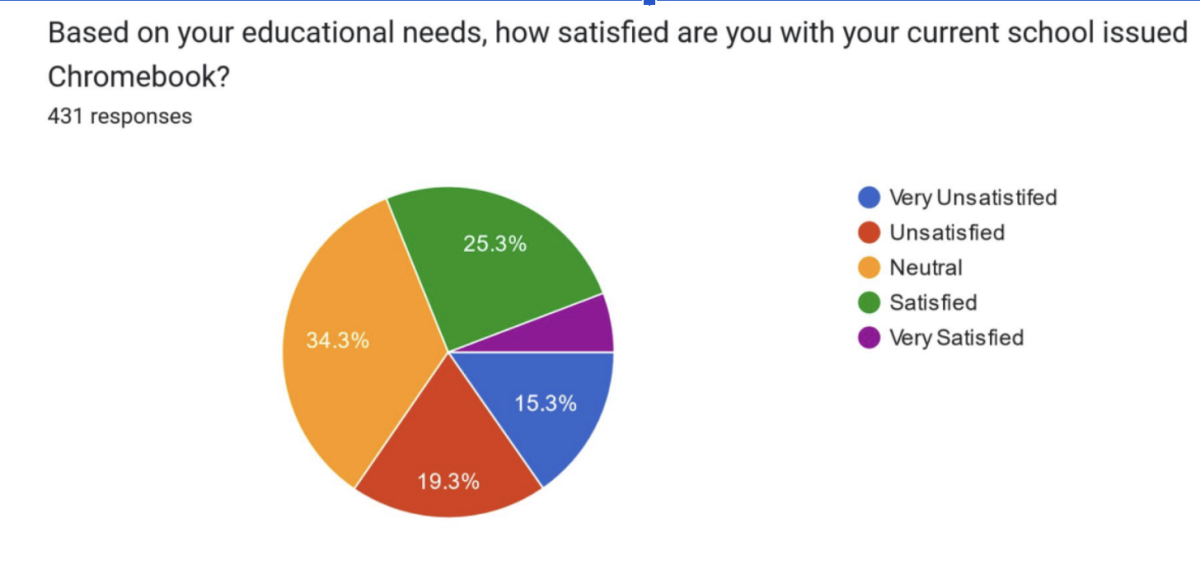
As a result, the administration sent out a variety of surveys in 2022 to assess student satisfaction. Out of 431 responses, less than 35% reported being content with their Chromebook, and more than 15% even stated they were “very” unsatisfied.
Those same respondents, when asked which device would most fit their educational needs, overwhelmingly picked the MacBook (76.8%).
MacBooks were faster, had better storage, and allowed increased access to creative applications. However, with better technology came a steeper price, which raised some initial concerns.
“I don’t even want to speculate how much money this school has spent on tech in the last 10 years, but I’m pretty certain we could have spent the money a lot better,” said Physics Teacher Mr. Matt Lowry, who has been a vocal opponent of technology reliance in classrooms.
Despite the cost, a slideshow was presented to the Board of Education on May 10, 2022 to explain the long-term economic value of MacBooks.
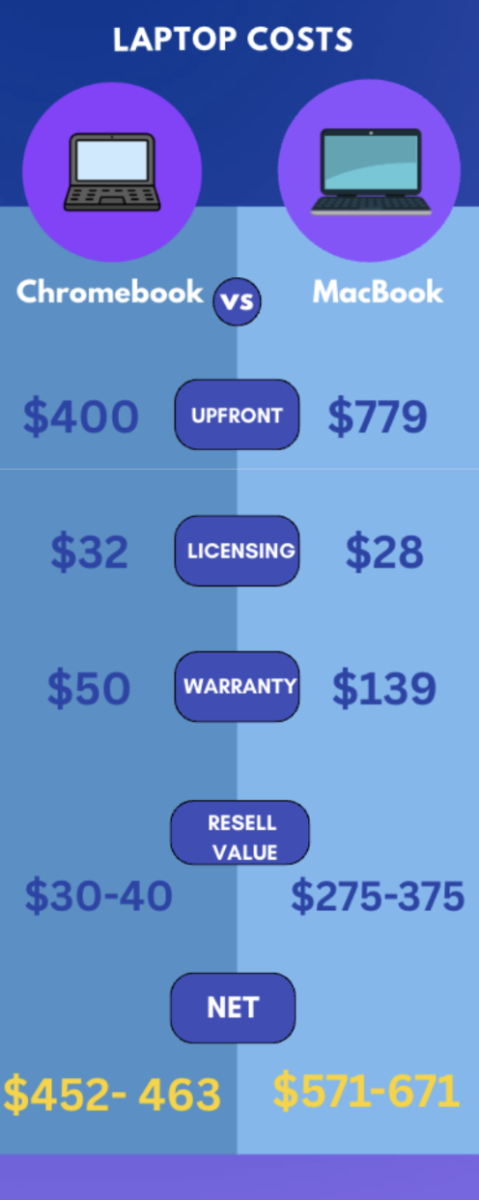
While the upfront cost of the Macs was significantly more expensive than Chromebooks ($779 compared to $400), the Macs had a much higher resale value.
The four-year value was only $30-40 on the Chromebooks, as opposed to $275-375 for MacBooks. This over 800% increase was significant enough to help offset the cost difference.
“Economically, once you look at the total cost, it actually wasn’t more than Chromebooks,” said District 115 Chief Technology Officer Mr. Jordan Salus. “MacBooks just hold their value better.”
As schools across the nation continue to integrate new technology into daily learning, one-to-one programs are becoming increasingly common. Supporters say these programs can create a more equitable and efficient learning environment, giving both students and teachers a consistent digital platform to work from.
“One-to-one access helps create that more consistent baseline for everyone,” said Mrs. Grigg.
Many educators observe that every student having access to the same device levels the playing field. That consistency also changes how teachers design their lessons. Instead of working around varying levels of access to technology, educators can fully integrate digital tools into their classrooms.
“Everyone being on the same device means teachers can actually plan around the technology instead of hoping it works,” said junior Vedh Krishnan. “Assignments, research, and collaboration all happen in one place. Standardization is the real win.”
In addition to voicing improved lesson planning, educators who have embraced technology point out that one-to-one programs significantly reduce reliance on traditional materials, like paper and pen. This shift not only cuts down on waste but also helps students and teachers improve their organization.
“There are fewer handouts and working with paper, so I can do a lot more stuff online, which helps to organize both me and the students really well,” said English teacher Mr. Lance Ferges.
For certain courses, technology is not only helpful but essential. Classes that rely heavily on research, writing, and collaboration benefit the most from digital access across all students.
“Technology can be really great for you in AP Seminar,” said history teacher Mrs. Cheryl Kyrias. “We wouldn’t be able to have the class without it. They write their papers online, use the internet for research, and, as far as supporting collaboration, when the kids do their group presentations they all have access to things like Google Slides and can be working on it at home.”
Communication is another area where one-to-one programs make a noticeable impact. Digital platforms allow teachers to share materials, assign work, and provide feedback more efficiently than ever before–improving teacher to student communication in many educators’ eyes.
“Technology has enhanced learning because I’m able to push work through Schoology to the students,” said Mr. Ferges. “I feel like communication between teachers and students is really great because of that.”
Beyond academics, schools also see one-to-one programs as a way to help manage students’ online activities.
“We are making sure your digital footprint is one that you’re proud of,” said Principal Dr. Erin Lenart.
However, while technology offers many advantages, educators emphasize that it is ultimately a tool, not a guaranteed success. Its effectiveness depends on how it is used.
“Technology is an amplifier as it multiplies whatever you bring to it,” said Krishnan. “Typing an essay instead of handwriting doesn’t automatically make the essay better, but it lets me revise faster, research on the fly, and focus on ideas instead of cramping my hand. If you’re already a thoughtful student, tech makes you more effective. If you’re not, it just helps you produce mediocre work faster.”
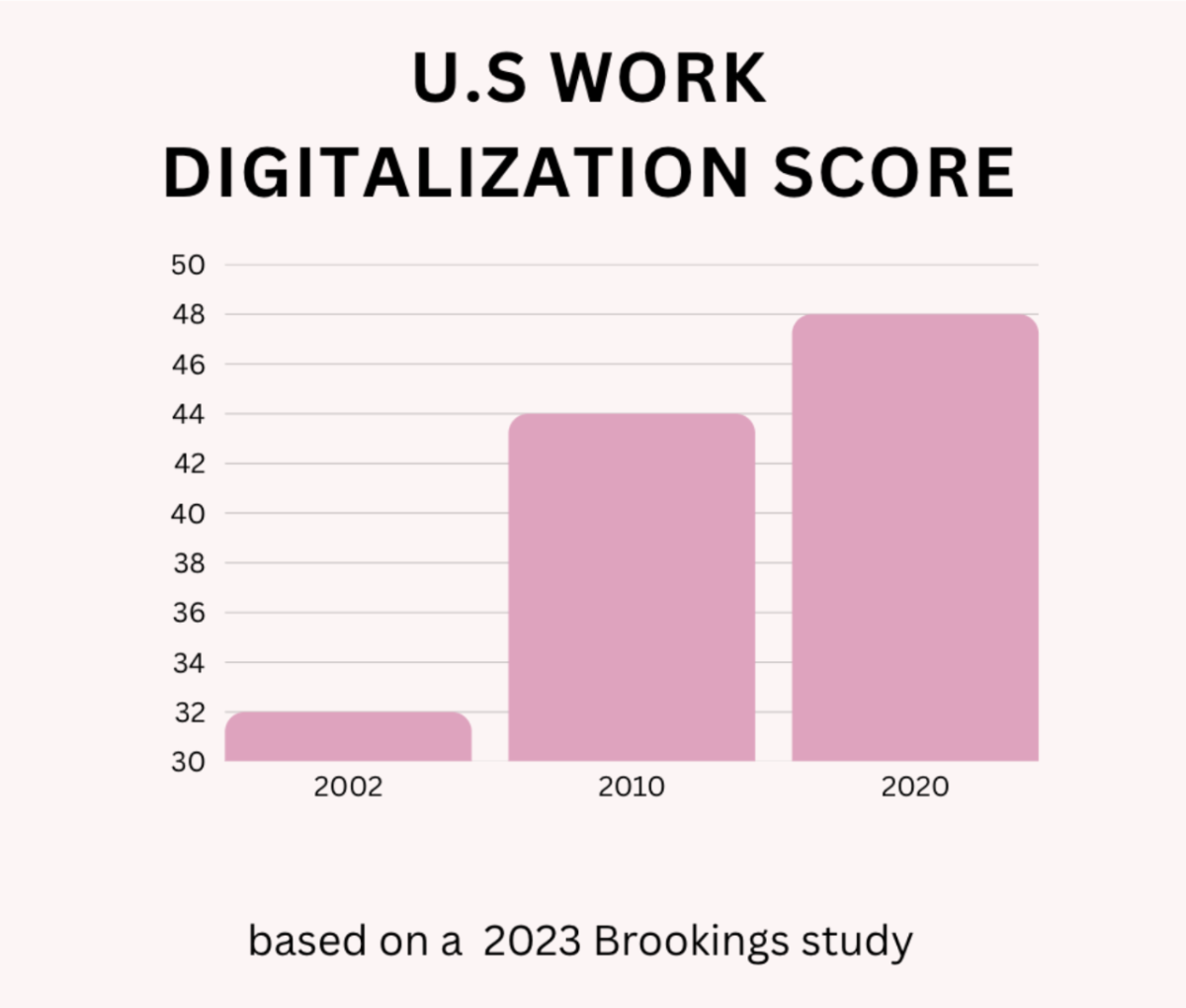
While critics question the distraction and analytical decline Macbooks can bring, it is not just high schools that are undergoing the trials and tribulations of adjusting to a society driven by technology. Universities and workforces alike are navigating how online tools play a role.
A 2023 survey from the World Economics Forum revealed that 86% of organizations were expected to adopt digital platforms before 2027.
Technology’s reach is spreading far and wide, and in doing so, becoming impossible to avoid in the job-force.
“Doctors, attorneys, accountants, all the sort of white collar work that we see a lot of our students moving into,” said Mr. Salus. “The reality is that technology is inherently going to be a part of those professions.”
Tech-positive educators highlight that being exposed to digital resources in high school provides students with the opportunity to build their skill set and have a better understanding of how technology can be utilized before entering the professional world.
Similarly, testing the limits of Macbooks now enables the chance to experiment creatively without major risks. Teachers are able to push students to try new softwares and work around any technical difficulties they may encounter without putting a grade, or a position, on the line.
“We need to learn how to use [tech] in a place where we can fail and learn from it, so that, when we are out in the real world, we know how to use it and we know how to use it responsibly,” said Mr. Salus.
The growing reliance on technology has made it so digital literacy is becoming just as important an ability as traditional academic skills. Without the opportunity to engage with technology early on, students may find themselves at a disadvantage once required to adapt to these tools after college.
“I think people recognize that we’re in a world where tech is going to be a part of your future, and so we need to get you started in high school,” said Dr. Lenart.
Your donation will support the student journalists of Lake Forest High School. Your contribution will allow us to purchase equipment and cover our annual website hosting costs.