

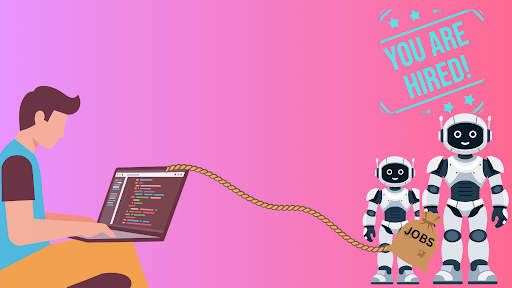
For more than a decade, the message to students was clear: Go to college, earn a degree, and find a stable career in white-collar field like business, law, or technology.
However, the rise in artificial intelligence may potentially put these “safe” white-collar jobs in jeopardy. At high schools and universities across the country, that uncertainty has generated a growing fear that AI will drastically reduce the need for jobs that students once assumed were secure.
“This is a very challenging time for students who were told by tech companies and the whole tech ecosystem over the last 10 years to just learn how to code, and you’ll get six-figure jobs coming out of college,” Career Pathways Department Chair Steve Douglass said. “It’s just not true going forward.”
A Changing Job Market
Artificial intelligence can already perform many of the tasks that define knowledge-based work, including analyzing data, summarizing documents, writing reports, creating graphics, and even producing computer code.
At the same time, new labor research is raising concerns that the jobs most vulnerable to AI are the ones students are often encouraged to pursue. Consulting firm Challenger, Gray, & Christmas reported that AI was responsible for 55,000 layoffs last year while the World Economic Forum reported that 40% of employers expect to reduce their workforce where AI can automate tasks. Many of these are so called white-collar jobs that require college degrees.
Companies are not only cutting jobs, they are also changing their focus. Reuters recently reported that businesses are shifting money towards AI systems that can handle tasks once done by employees, adding to concerns about white-collar job security.
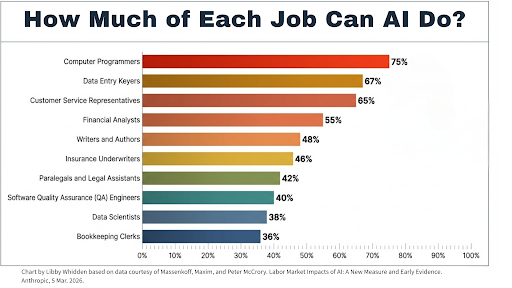 “I’m incredibly fearful for the future,” said junior and co-founder of the AI Club Kaden Gray Gross. “People are being laid off… any job without a physical aspect… is at risk.”
Her concerns are reflected more broadly in the job market. A recent New York Times article, citing data from the Federal Reserve Bank of New York, found that unemployment among recent college graduates has risen sharply. This adds to concerns about the value and marketability of a traditional college degree.
Still, the picture is not entirely negative. The World Economic Forum’s reported that although AI and information-processing technologies may displace some jobs, they are also predicted to create millions of additional jobs.
That shift is already changing how teachers talk to students about the future. For years, students were told to focus on technical skills–particularly computer coding–as a reliable path to a high-paying job.
Now, that advice is much less certain.
“It’s really hard to make decisions based on uncertainties, and this generation already feels a lot of uncertainty,” counselor Mrs. Megan Miles said. “We encourage students to pursue their passions and learn how to utilize AI to benefit their career field.”
Rethinking College and Careers
For students preparing for college, those shifts are already influencing how they think about college itself. What once seemed like a topic limited to cheating and academic honesty, AI is now affecting students’ majors and career plans.
Education Week reports that a quarter of students say they are no longer considering a particular major because of AI-informed research and 17% say they are now considering a new major.
Gray Gross said that has made college planning feel more risky.
“Personally, it makes me uneasy about the future because it feels like no career path is truly secure anymore,” Gray Gross said. “I do not have a clear idea of what to major in that would be ‘AI-proof,’ which makes any decision hard. It also makes going into debt for college seem incredibly risky.”
Other surveys show AI is reshaping the college search itself, as some weigh whether a possible major could lead to a career that may not exist by the time the student walks across the graduation stage. That leaves students with two competing messages: AI may take away some jobs, but it also may reshape others and create new opportunities. Both are circulating at the same time, causing confusion.
Few LFHS students have worked with AI as closely as junior Vedh Krishnan. In a November article in The Forest Scout, he described creating an AI chatbot based on the lectures of history teacher Mr. Thomas Gigiano to help students get personalized help outside of the classroom.
For years he assumed he would major in computer science. Now he’s not so sure.
“Rather than choosing a major based purely on job security, I want to focus on developing logical thinking, adaptability, and the ability to work across disciplines. Ultimately, I am interested in majoring in an AI-related field, likely in combination with another area, but I am still exploring,” he said.
Krishnan is thinking about how AI could expand, rather than replace, the work done by humans.
“In the long term, AI may reduce traditional job paths but it may also create a future where more individuals have the freedom and capability to design their own careers,” said Krishnan, who attended the AI in Education Summit hosted by the Khan Lab School.
Krishnan’s view suggests that students aren’t just reacting to AI: they are actively trying to figure out how to work along with it.
“If these technologies continue improving, they could lower the barrier to entrepreneurship in a massive way. A single motivated founder or a small student team could build and scale projects that once required entire organizations,” he said. “I do believe AI will take over many routine white collar tasks. However, I also believe it will expand opportunity.”
How Schools Are Responding
Some educators are pushing for a different focus in the classroom as a result of these changes. Instead of preparing students for one specific job, educators are refocusing on skills that can adapt across industries that are likely to change.
Math teacher and AI Club sponsor Mr. Brian Runft encourages students to focus on “learning how to learn.”
“The school needs to emphasize … critical thinking and problem solving,” Mr. Runft said. “But they sometimes get lost in the curriculum.”
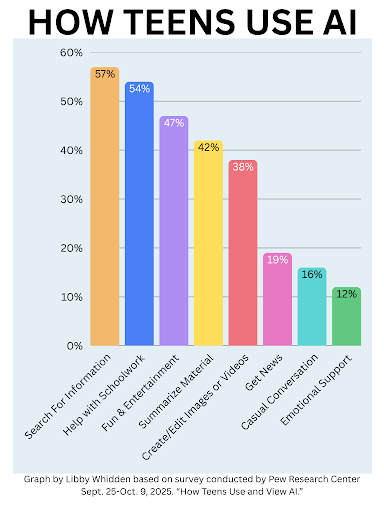 That shift in emphasis is showing up in terms of classroom assignments. Some teachers now require handwritten work, in-class essays, and discussion-based activities–tasks that are harder for AI to complete. Others are encouraging students to use AI responsibly, seeing it as a skill that will be necessary in the workforce. Together, these approaches reflect that larger uncertainty schools are still working through.
“Learning the core skills of thinking critically, problem solving, and creativity will be more essential than the major you pursue. Higher education is very slow to adapt, so students need to find mentors who will help them navigate this process in real time,” Mr. Douglass said.
This uncertainty has also begun to shape policy. According to the National Association of State Boards of Education, 34 states have already taken initiatives to craft AI guidance policies in K-12 public schools. Illinois has plans to solidify its state policy by July 2026.
For many educators, the issue is not about whether students should or should not use AI. It is about how schools can balance academic honesty with the reality that AI tools are already part of higher education and the workplace. Rather than banning AI outright, some teachers are focusing on teaching students how to responsibly use AI by recognizing when AI use crosses the line and how to evaluate the responses it produces.
History teacher Mrs. Cheryl Kyrias permits students in her AP Seminar class to use AI for brainstorming topics. However, she is clear that AI should not be used for writing, and students upload all assignments to TurnItIn.com.
Maintaining that balance can be difficult for students, especially when expectations vary from class to class. Some say that inconsistency makes it challenging to know what responsible AI use looks like. Those mixed signals also lead to a broader concern: whether schools are more focused on controlling the technology than on preparing them for the future.
“I think teachers aren’t doing the right things to prepare us for a world with AI,” Gray Gross explains. “Schools focus on memorization, traditional skills, and general knowledge, even though AI can perform those tasks quickly.”
At the same time, teachers and counselors continue to stress that not all jobs are equally vulnerable. Jobs that require interpersonal skills or physical presence, such as education, healthcare, and skilled trades, may be less likely to be affected by automation. Even in fields already being impacted by AI, educators maintain that jobs requiring human interaction will be difficult to replicate using AI.
For students trying to prepare for their future, though, that distinction does not make future planning easier. Miles said that while many jobs will be affected by AI in ways that are hard to predict, students should not abandon their interests altogether.
“We would encourage students to pursue their passion and learn how to utilize AI to benefit their career field,” she said.
Even as experts debate the long-term effects of artificial intelligence, students are already navigating its effects.
For students here, the discussion about artificial intelligence is not just about use and misuse in the classroom. It is already shaping how they imagine their future, while raising new questions about what it means to plan for a world that is still changing.







Heide Boven • May 5, 2026 at 12:56 pm
I will be sharing this with my grandson to help him think about his choices in his education.
Thanks Libby. Your Gramma’s friend.
Heide. I don’t use my email, but you can text me at 616-516-5xxx.