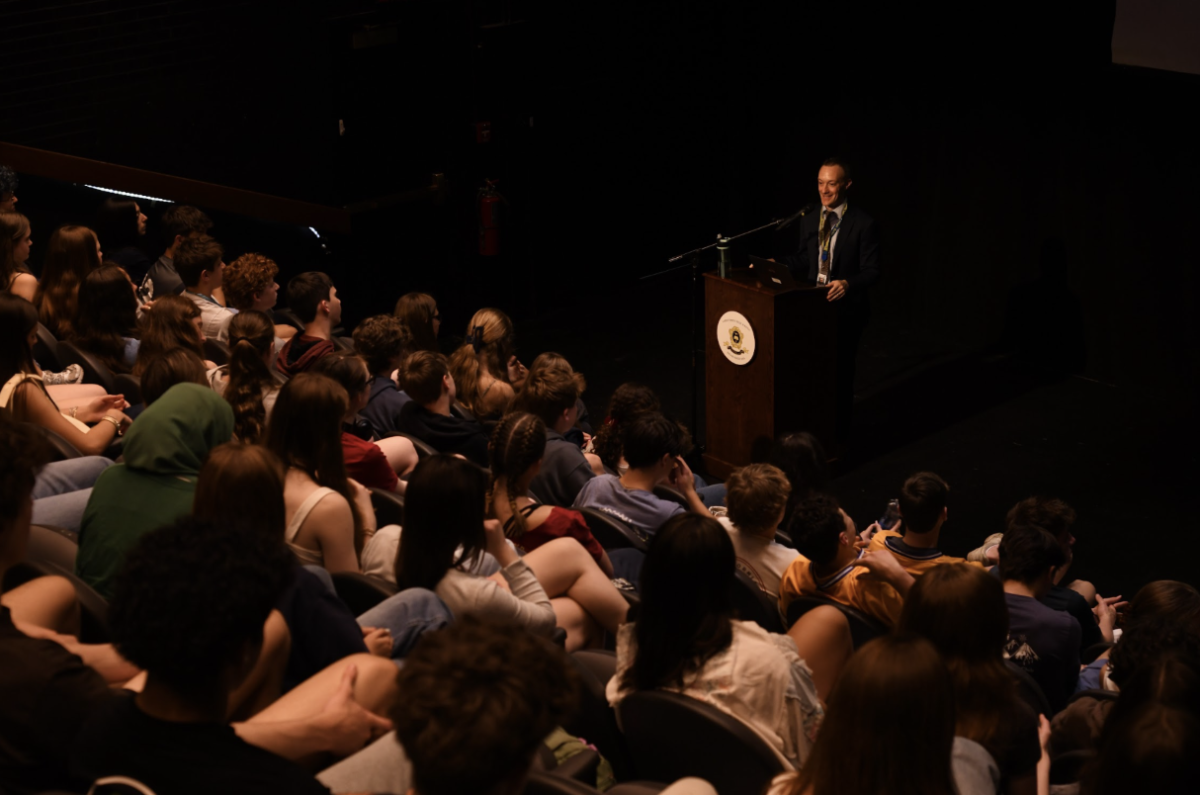
On Holocaust Remembrance Day this week in the Little Theatre, history teacher Mr. Michael Soffer spoke about his experience at Oak Park River Forest High School (OPRFHS) and how it led to the creation of his book: Our Nazi.
The book investigates Reinhold Kulle, who worked as a custodian at OPRFHS. Kulle worked at the school from 1959-1984, and it was revealed in 1983 that he was a former Nazi SS guard at the Gross-Rosen concentration camp. After learning about Kulle’s former Nazi affiliation, members of the community were shocked that Kulle had avoided suspicion for so long while working closely with teachers and students.
More than a decade after the incident, Soffer, who had attended OPRFHS, was employed as a history teacher at his alma mater. Having noticed a rise in antisemitism, he created a Holocaust studies class which focused specifically on antisemitism in an effort to address this problem.
“We had had a bunch of antisemetic hate crimes at the school. So much so that if we had gone a week without one in the fall of 2018, teachers would celebrate,” Soffer said.

In this class, Soffer referenced Kulle’s case in order to relate historical events to the community. Students were particularly interested in discussing the community’s response, but Soffer said that, at the time, he did not have enough information to be able to answer their questions. As a result, he began researching and even cold-calling people who were involved. After a conversation with the former school board president from when Kulle was employed, he spoke to his wife about the call.
“I was telling my wife about the phone call, and she said ‘So you’re gonna write a book,’” Soffer said.
Soffer said that at first, after his wife mentioned the idea of a book, he had no intention of actually writing one. However, he said that over the next few months, as he learned more, writing a book became more realistic.
After roughly three years of writing the book, it was published in October of 2024. Since then, Soffer has spoken in the media and publicly at schools and universities in the Chicago area. Most recently, with the help of librarians Ms. Katie Pausch and Mrs. Lauren Fairchild, Soffer spoke with students here.
During his presentation, Soffer explained how he wrote his book not only to explain what happened to Kulle, but, just as his students wondered, how the community reacted. Members had differing opinions regarding Kulle: some defended him and others advocated for his immediate removal.
Soffer said that those who defended Kulle followed a similar pattern. At first, some would deny the accusations, but once it was obvious that they were true, they would justify and downplay Kulle’s involvement at the camp. Finally, they would push for forgiveness by claiming that it was the most moral response.
When asked about what he wanted students to take away from his presentation, Soffer said he wanted them to understand the importance of exploring inconsistencies in our past.
“We have a very rosy retrospection about America’s involvement in World War II and the response to the Holocaust,” Soffer said. “I think revisiting…what our narratives are and how the actual truth doesn’t always match up…[is] an important thing to do.”