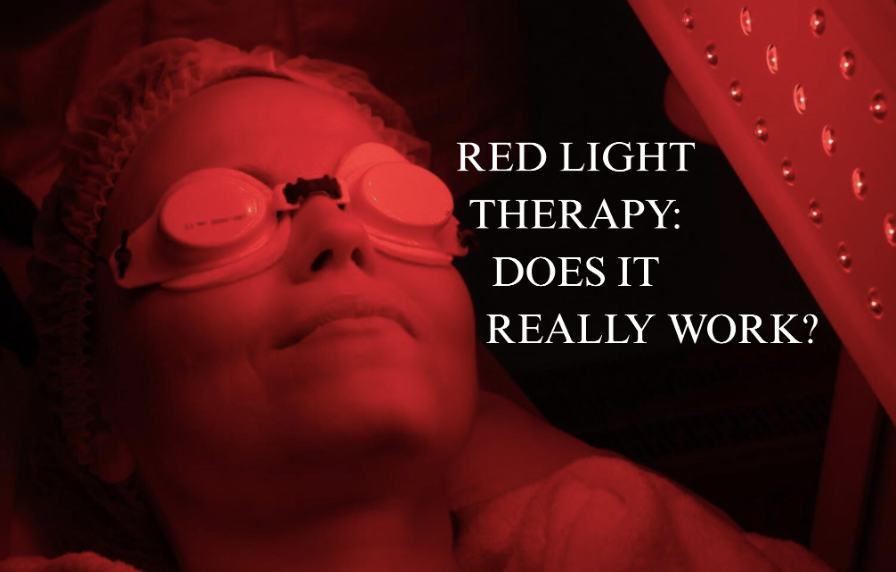
Red light therapy has taken over the internet, as the $350 Shark CryoGlow Mask has been all over my social media feed. They claim it has anti-aging benefits and that it clears up acne scars and breakouts. But, is that really true?
The global market is projected to pass $1 billion by 2030 because of the wide ranging benefits, arguing that it can help aging skin and redness.
The microtrend is stimulating the economy, but is that just the effect of social media influencers on their followers?
Some clinical studies have even argued that it can help improve peripheral neuropathy (damage to different nerves that branch out from the spinal cords) and retinal degeneration (gradual damage to the light sensing part of the eye that is responsible for sight.)
Light is something that is known to benefit humans. It is widely accepted by scientists that ultraviolet light (UV light) is a large factor in vitamin D production. Not only that, but bright-light therapy is a standard treatment for seasonal affective disorder, most commonly known as seasonal depression.
Unlike UV light, red light therapy doesn’t pose the same risks that come from UV light, like skin damage. Red light therapy is minimally invasive and the worst side effect that comes with the treatment is skin redness, but that’s only temporary.
Red light therapy is medically known as photobiomodulation or low level laser light therapy. Red light therapy devices emit red or near-infrared light that is aimed directly at the skin that stimulates the mitochondria in turn, this speeds up tissue repair and skin recovery.
“I would say I use my red light mask about three or four times per week. I was on Accutane, which resulted in a lot of acne scarring and I started using my red light mask consistently– I have no scars on my face anymore,” says junior Nina Loiacano.
Red light therapy has benefits proven across LFHS, but also proven in research studies.
Not only does red light therapy improve skin health and tissue repair, Hugo Francisco de Souza from News-Medical argues that it can reset a user’s circadian rhythm, effectively resetting internal clocks.
“This resetting mechanism translates to a 32.5 minute increase in total sleep time and 3% improvement in overall sleep efficiency,” believes Francisco de Souza.
Despite these benefits, so many don’t believe that red light therapy actually works. It requires direct consistency, between busy days, forgetting and not knowing how to use it, people don’t see results immediately. This usually discourages users.
Red light therapy is not an instant solution, it takes time and the results aren’t consistent person to person, everyone is biologically different so results differ.
At LFHS, red light therapy is most commonly seen in the Atheltic Trainers Office, where athletes will point a bright red light at a bruise or point of injury. The most commonly heard phrase in the trainer is “why don’t you go ice and laser?”. If red light therapy has superficial benefits, can it really help beneath the skin on a deeper level?
“Red light therapy can be helpful for many common sports injuries, including sprains, strains, tendonitis, bruises, and turf burns,” says trainer, Jen Regan. “Smaller, more surface-level injuries heal the fastest. Turf burns may improve in just 3 or 4 days, bruises in about 5 days, and sprains or strains in around 2 weeks.”
Red light therapy has benefitted LFHS students, especially with sports injuries.
“I usually use red light therapy whenever I’m dealing with sore muscles or an injury, so after I sprained my ankle,” says junior Keelin Oesterlein. “ I started using it almost every day. I didn’t notice any instant or dramatic results, but I do feel like my ankle healed faster than it did with previous sprains when I consistently used the red light therapy mat.”
There is science that explains it all. Red light therapy (Photobiomodulation) that is applied before or after exercise may improve muscle performance, enhance muscle recovery, reduce delayed onset muscle soreness (DOMS) and increase the gain in muscle mass after intense training.
Red light therapy shows a lot of potential to improve athlete performance and recovery, but there is not enough evidence to create treatment guidelines. It is a great start for red light therapy to gain scientific traction. This doesn’t mean that red light therapy doesn’t work, it just means that doctors cannot establish it as a standardized treatment. The benefits are real and seem to be worth it.
Red light therapy is not a miracle cure, but growing evidence argues that it has real benefits for skin health and recovery as well as muscle recovery. But, results are definitely not the same for every user. The increased use of red light therapy in medicine, athletics and skin aesthetics prove that red light therapy is not just any internet microtrend, the benefits are real.
Next time you have a sports injury, be sure to visit the trainers for a classic ice and laser treatment, the result is worth it!