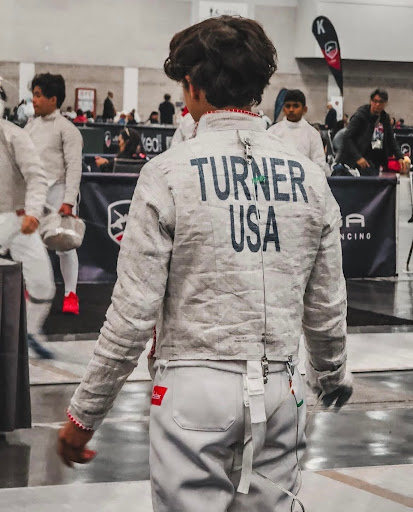
You may know freshman Ben Turner, but what many don’t realize is that he is one of the very few fencers at LFHS. Turner competes in tournaments across the country, representing both Team USA and the Midwest Fencing Club.
Fencing is a very uncommon sport. How do you explain fencing to people that have never heard of it before?
“Well, fencing is a combat sport where you use swords to try to hit your opponent first. And then there are all these rules about right of way and priority; it’s pretty complicated. But if I were to compare it to another sport, I would say it’s probably like physical chess.”
What started your passion for fencing?
“When I was younger, I had to read this book for school. I don’t really remember what book it was, but it had this whole section on it about fencing, and I tried a bunch of other sports, and I didn’t like many of them, so I told my mom I wanted to try fencing. She signed me up for the class at the Gordon Community Center, and the coach was super nice, and he’s actually my coach to this day. So that ignited my passion.”
What is the hardest part about fencing?
“I would say fencing is really a mental battle. For example, in between touches and points, you have to constantly be thinking about what you’re gonna do next, how you’re going to adjust, and keeping the momentum of thinking about touches. This happens constantly, and not giving up when you’re losing a couple of points is the hardest part.”
What was your favorite tournament and why?
“I would say that. My favorite tournament to go to is usually the March NAC, North American Cup, because every year they hold it at the Fort Worth Convention Center, which is pretty cool. It has this massive dome, so it’s super cool. But my most memorable tournament was Summer Nationals last year, where I got 27th out of 200.”
How often do you practice, and what does a normal practice look like?
“I practice 5 days a week, usually at the club, and then outside of that, I do a lot of sprinting and some weight training. A normal practice at the club starts at 7.30, and it goes for 2 hours until 9.30. Usually, we’ll get there, we’ll warm up a little bit, and then go into a workout, ply-metrics, or something like that for about 30 to 45 minutes, then we’ll do a little bit of footwork or blade work. It’s like working on technique. So, that usually takes an hour and 15 minutes, and then we have 45 minutes of just free fencing.”
What are the biggest challenges you’ve had to overcome?

“It’s hard to keep up with schoolwork because of how much practice there is. I would say probably just the balance of school and fencing is pretty hard to keep up with because I struggle to find time to do my homework in between all of my practices. So my grades suffer.”
Who has been a role model to you throughout your fencing journey?
“I would say my coach, Bart Pucal. At his peak, he was one of the best fencers in the world. So I’m really grateful to be able to train under him and have such a great coach who pushes all the other kids in my club to do better. He really inspires me.”
What do you want people to take away from this article?
“I want people to take away that even though fencing is a pretty small community, it’s still a really
great sport, and you can learn a lot from it.”