
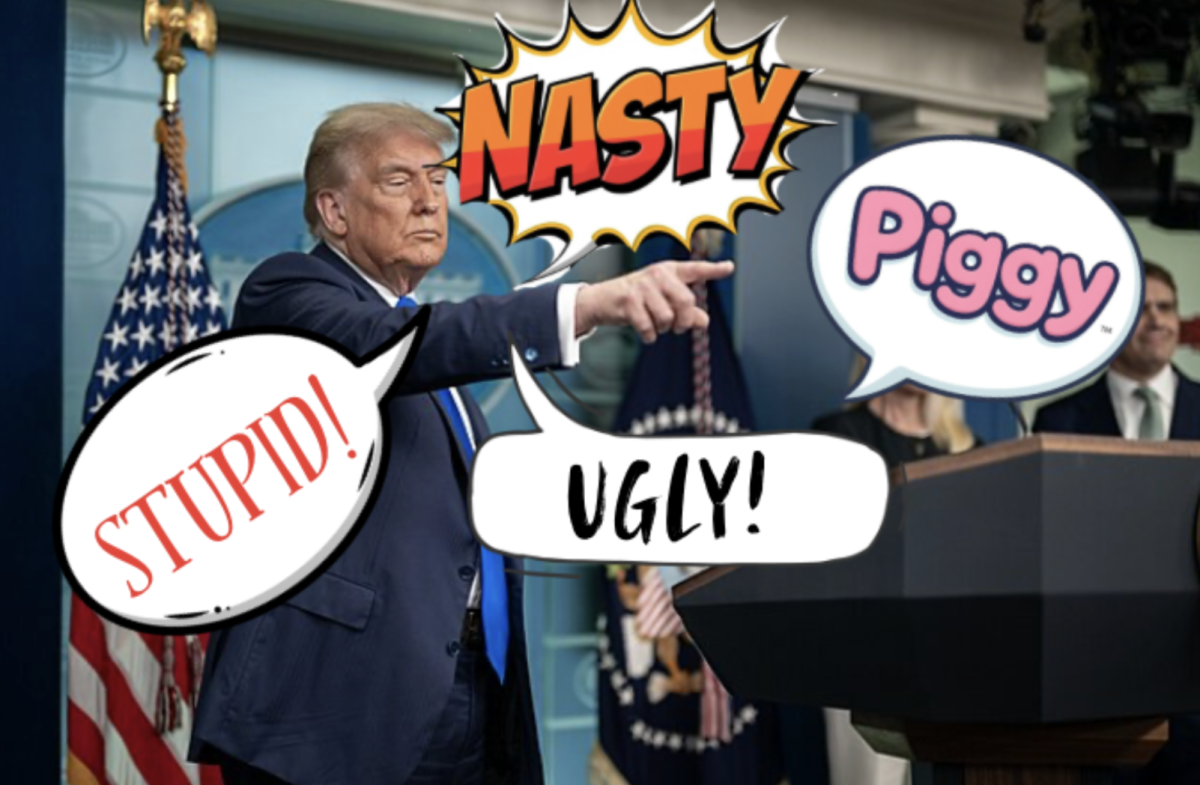
When Bloomberg reporter Catherine Lucey asked President Trump a question on Air Force One this past fall, she didn’t get an answer. Instead, she was told “Quiet. Quiet, Piggy.”
The moment went viral almost immediately. What ended up getting lost in the chaos was an answer to her question about the Epstein files, an issue that many Americans, on both sides of the political aisle, wanted clarity on. Lucey was just doing her job, but somehow she herself became the story instead of the issue she was trying to cover.
For high school students, especially girls who dream of becoming journalists, situations like this can feel discouraging. Additionally, these situations normalize behavior we should not tolerate.
Unfortunately, according to Axios, President Trump’s mistreatment of female journalists is not just a one-time thing. He has escalated his attacks, calling female reporters “stupid” and “ugly,” ” which the Society of Professional Journalists labels as “an unmistakable pattern of hostility.” When the country’s highest-ranking public official acts this way toward female journalists, it sends a signal that disrespecting women is normal behavior.
In December Trump went after CNN anchor Kaitlan Collins on Truth Social, calling her “stupid and nasty” (and even misspelled her name.) Collins did not respond with insults. Instead, she simply clarified that she had asked him a direct question about Venezuela. Her reply was very different from President Trump’s personal attack and showed how women reporters often need to stay calm even when they are being attacked.
Messages Sent to Future Generations
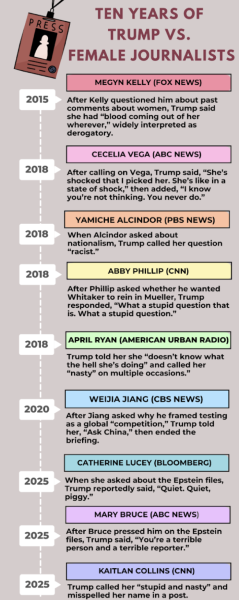
Moments like these raise bigger questions about the type of environment a young woman may be stepping into when she chooses to study journalism. These comments do not just sting: they affect how the public sees the press and how young women picture themselves doing the job. This kind of treatment does not just affect high-profile journalists at major media outlets; it also sends a message to young women who are just starting out in the field.
Studies show this effect starts long before women reach the floor of the White House briefing room. Young female journalists often face gendered harassment or feel pressure to leave the field entirely. A UNESCO global report found that nearly three out of four women journalists have experienced online harassment while doing their jobs and that younger reporters are especially vulnerable because they depend on social media for career-building.
Another study from the Center for Media Engagement found that many early-career women said harassment made them question whether they wanted to stay in journalism at all. Some even avoided certain stories out of fear of being targeted.
For teenage girls watching these moments unfold, journalism can begin to seem more intimidating than inspiring.
Beyond the Media
The way powerful men speak to female journalists sends a signal to viewers that this is an appropriate way to speak to women.
“When a president publicly humiliates a reporter for doing her job, others in the room internalize the cost,” said Kiran Nazish, founding director of the Coalition for Women in Journalism.
In other words, every insult sends the message to women that asking tough questions comes with consequences.
The consequences are not only verbal, however. In a panel discussion hosted by Ms. Magazine, multiple women journalists described facing physical threats in addition to online harassment.
“There is an open hostility to journalists… you need to be aware of the risks,” Los Angeles reporter Cerise Castle said.
Castle has experienced intimidation and even physical force at political events. These experiences go far beyond what should be considered a normal amount of stress for a reporter.
The statistics about the abuse and harassment of female journalists are also shocking. Even though the United States is known as a country that celebrates free speech, it has more violations against female journalists than countries such as Iran. Of note, the US does have more female journalists than Iran.
For students looking up to female journalists, it is not hard to understand how these moments can change the way young people see the profession. Former Fox News anchor Gretchen Carlson said that publicly insulting women journalists creates “generational damage” because it teaches young men that disrespect toward women is acceptable and teaches girls that they will be devalued even when they succeed.
Silence Sends a Message
The recent news events are shocking not just because of what was said, but also because of the lacking response. Fatima Goss Graves, president of the National Women’s Law Center, pointed out that what shocked many people about the “piggy” remark was not just that Trump said it; it was the fact that everyone else in the room kept going as if nothing had happened.
When silence becomes normal, sexism becomes normal too.
And yet, despite all of this, women journalists continue to show impressive resilience. Kristen Welker, a White House correspondent for NBC News, told The Everygirl that the job can feel like “an old boys’ club,” but she has learned to be more confident and outspoken.
“If you work hard, you will achieve all of your goals,” she said.
That message may be just what young female journalists need now.
Turning Attacks into Motivation
Even Castle, who has faced some of the harshest conditions, told Ms. Magazine, “There will always be journalists to stand up and fight.” The fact she faced harsh insults for simply doing her job but still reminded interviewers that she is doing the hard work others will not do highlights the bravery female journalists have..
LFHS has played a role in inspiring many former The Forest Scout writers to pursue journalism, which is definitely needed. These students, despite knowing the reality of the profession, are still willing to pursue it.
LFHS ‘23 alumna Vivi Hirschfield, majoring in journalism at University of Missouri, is optimistic.
“I have noticed an overwhelming presence of other female students in my journalism courses, and there are a number of on-campus organizations for women in media and journalism,” said Hirschfield.
The persistence of female journalists shows why their work is still worth doing. Even when they are faced with harassment or insults, these women continue to ask questions and work. This kind of resilience holds even the most powerful people accountable and makes sure those watching know that women should not be silenced and that talking down to them should not be allowed.





@realdonaldtrump • Mar 7, 2026 at 8:42 pm
Wow. Just read this very long article—very long, maybe the longest article ever written about me, honestly—and I have to say, a lot of people are talking about it. Everybody’s talking about it. They say, “Sir, did you see what the school newspaper wrote?” And I said of course I saw it, I see everything. Tremendous readers, tremendous attention.
First of all, I have tremendous respect for journalists. Nobody respects journalists more than me. I talk to them all the time—probably more than any president in history. Some people say maybe too much! But when you’re answering questions from reporters every single day, sometimes things get a little loud, a little chaotic, a little exciting. Air Force One is a busy place, folks. It’s not a library.
Now they’re saying I’m “mean” to reporters. Mean! Can you believe it? I answer questions constantly—sometimes very nasty questions, very unfair questions. The fake news media, they come in hot. But I still answer them. And when someone interrupts, everybody’s talking at once, you say “quiet” so you can actually answer the question. That’s called running a press conference. It’s not a tea party.
And by the way, nobody mentions the question itself! They never do. They focus on one little phrase, clip it, put it on social media, boom—viral. Meanwhile the real story disappears. Happens all the time. It’s the oldest trick in the book. Some of these reporters are very good at it, I’ll give them credit.
Also very interesting—this whole thing about discouraging young journalists. I don’t want to discourage anybody! If you want to be a journalist, go for it. Ask tough questions. Just be ready for tough answers. That’s how it works in the real world. Journalism isn’t supposed to be easy. If it were easy everyone would do it, and believe me a lot of people already do.
And let me say this: strong reporters exist everywhere—men and women. Some of the toughest reporters I deal with are women. Very tough. They come at you with 10 questions at once. Total professionals. I respect toughness. Always have.
But the media loves a drama. They take one moment, stretch it out for three months, write essays, panels, studies, the whole thing. Meanwhile the country has about a thousand bigger issues going on.
So to the students writing this: keep asking questions, keep writing articles, that’s great. Journalism needs energy. Just remember—when you step into the arena, people will answer back. Sometimes loudly. That’s not intimidation, that’s politics. And politics, folks, is the toughest sport in the world.
Anyway, great passion in the article. Really tremendous passion. Maybe next time write one about something small… like the economy or world peace. Big topics. People love those.
. • Mar 7, 2026 at 8:33 pm
yes he treats journalist poorly but he treats male journalist just as bad
# allison coooper
MD • Feb 6, 2026 at 10:43 am
Ironically, most of these comments validate exactly what you’ve written. It’s disheartening to see a budding female journalist attacked by her own community. Keep using your voice, exercising your freedom of speech, and speaking out against nasty misogyny.
Anonymous • Feb 4, 2026 at 12:41 pm
People who are attacking this article purely because it states facts against someone they like show the terrible polarization in this country. The fact that people are personally attacking someone for calling out the fact that our president has a history of demeaning women is sad.
Anonymous • Feb 3, 2026 at 8:05 pm
Women are considered secondary citizens in Iran. Iran does not have journalists or any free press. Women have no sound or any voice whatsoever, so comparing them to the rights of female journalists in The United States is just irrelevant. Hope this helps.
Anonymous • Feb 3, 2026 at 1:36 pm
Fie on the hour when honor is undone,
And scorn is sport for those in power set high;
When she who seeks but truth in duty done
Is met with jests that shame both tongue and eye.
What poverty of spirit thus is shown,
That might must mock where reason should reply?
A throne is made the smaller by such tone,
And dignity doth in the dust then lie.
Mark well: the wound is not to one alone —
Young hearts behold, and learn what to defy.
Where silence walks, there cruel seeds are sown;
Such speech doth wrong both present age and nigh.
Not hers the stain, who steadfast stood to ask,
But his, whose words betrayed so poor a mask.
Anonymous • Feb 2, 2026 at 11:42 am
If you think Iran is better for female journalists, or just women in general, how about you take a trip to Iran and report back about how women are not allowed to do anything without the consent of their husband! Some people are just so ungreatful for the state of affairs and all the progress weve made in terms of ensuring equality of results. Any ounce of research would reveal that Iran is one of the most hostile places in the world for women and even comparing the state of gender affairs between america and Iran exposes great ignorance about the subject.
Donald Trump Glazer • Feb 2, 2026 at 11:30 am
Lots of people are saying it’s one of the worst pieces of writing they’ve ever seen. The facts? Wrong. The sources? Nonexistent. I know the truth, everyone who actually knows me knows the truth, and frankly I’m doing tremendous. This is just another desperate attempt to get clicks, and it’s not working. We’re winning big, folks.
Anonymous • Jan 30, 2026 at 4:03 pm
Comparing freedom in the United States to Iran might just be the dumbest thing anyone’s ever done. Please share where you found absolutely anything to prove that.
In Iran: The situation for female journalists intensified following the “Woman, Life, Freedom” protests. Reports from groups like the Committee to Protect Journalists (CPJ) and Women Press Freedom (WPF) show that female journalists in Iran face:
• Lengthy Prison Sentences: Women have been sentenced to 5+ years for reports on women’s rights.
• Physical Abuse: Systematic reports of torture, beatings, and denial of medical care in prisons like Evin.
• Severe Judicial Penalties: Sentences including lashes, internal exile, and bans from practicing journalism.
Do your research and DO BETTER. If you think the United States is so bad go to Iran and see what will happen to you if you don’t cover up your face. Nice work!
Libby • Jan 30, 2026 at 7:03 pm
Hi! First off I love America. My full name is Liberty so believe me I was raised to be patriotic. However it is so clear you didn’t understand this article and missed the meaning. It’s about women in journalism dealing with hate. I did my research. Thanks
James Kanlip • Jan 30, 2026 at 1:50 pm
When I was a freshman, this page was reserved for genuinely talented writers who produced thoughtful, engaging articles. Now it’s filled with pieces written by people who clearly don’t understand the topics they’re covering. It’s disappointing that something once respected has been allowed to decline like this.
Kristen C • Jan 30, 2026 at 4:48 pm
This is a very important topic to women. It is totally inappropriate for these insults to be delivered by the person holding the highest office in the US.
EC • Jan 30, 2026 at 12:33 pm
Girl omg this is so good. Literally sent it to my whole family and it was amazing I love how you are always sticking up for us girls! And fully putting politics aside it clearly shows you are a really good person and a girls girl. Love ya
Meredith • Jan 30, 2026 at 11:41 am
Great job Libby!
Luna • Jan 30, 2026 at 10:25 am
This entire piece is COMPLETE fake news. The opening incident never happened as described, and the article then stacks real names, selective quotes, and unrelated statistics on top of a false premise to push a narrative. When the foundation is fabricated, the conclusions can’t be taken seriously. I can’t believe you could post complete liberal propaganda in The Forest Scout.
Libby • Jan 30, 2026 at 11:19 am
Hi! Strong reporting doesn’t stop being true because it makes someone uncomfortable. The facts here are documented and sourced. This whole comment you posted pretty much proves my whole point of the article- so thank you and thank you for taking the time to read it!
LFHS alumni • Feb 3, 2026 at 8:45 pm
Notice how this article is in the IN OUR OPINION section??? You need to learn how to read AND COMPREHEND, Luna.