
To our current generation, the feud between red and blue seems everlasting. As we have grown up, political polarization has increased not only between government officials but also among everyday Americans.
During 2025, the US Congress—the 118th Congress—enacted only 42 laws, which is quite low compared to the usual hundreds passed in a two year time frame. Granted, they have another year, but at this rate they’ll likely pass around 100 laws in two years.
So why is this an issue, and what is causing this lack of productivity?
Many have already observed the main reason: the harsh political divide between Democrat and Republican government officials. This tense opposition recently led to the longest government shutdown in United States history, lasting 43 days during which the government could not operate.
By disagreeing over healthcare funding and causing the government shutdown, politicians left tens of thousands of federal employees without pay for over a month. While the average American often suffers as a result of political divisiveness, they also have a responsibility to prevent these tensions.
In my opinion, for everyday Americans, the conflict lies behind the idolization of political candidates. In other words, the issue stems from viewing politicians you support as righteous while blaming problems on officials lying on the other side of the political spectrum.
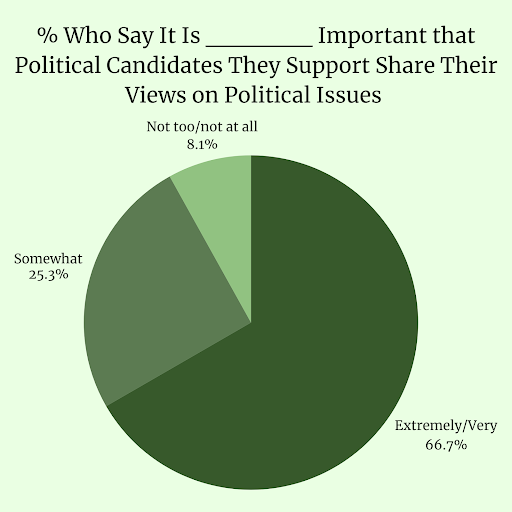
According to the Pew Research Center, 66% of Americans think it is extremely important—while 25% say it is somewhat important—for candidates to share their views on political issues, a far higher percentage than those who want candidates to have similar identities to them.
This data shows that most Americans want to see the values they support being represented in office. In theory, this reflects the key idea in representative democracies like America: officials in office should represent the issues and beliefs of the people who elected them.
Then how did this system, one that is supposed to represent American voters, result in the severe political polarization we are seeing today?
It appears to me that, by viewing government officials as figures who represent your exact ideas, Americans lose sight of the officials’ true purpose. If you believe someone accurately reflects your values are you going to be quick to criticize them? Probably not, as you see the official as a direct reflection of yourself and your own beliefs.
So, when inevitable problems arise in the United States—as a global superpower, national or international issues are bound to arise—politicians have the responsibility to resolve these conflicts. However, because many Americans are unable to hold the officials they support accountable to help fix the issue, they often resort to blaming the officials from the opposing side of the political spectrum instead.
This is demonstrated by the Pew Research Center finding that, among US adults, 72% of Republicans see Democrats as more immoral while 63% of Democrats view Republicans as more immoral. Rather than reaching out to contact the officials they elected into office, a majority of Americans look to the other side for people to blame.
These harsh reactions also stem from the extremism that is promoted online. In a poll of more than 14,000 American adults in 2024, Gallup found that 37% of them identified as very conservative or conservative, 25% as very liberal or liberal, and 34% as moderate. It’s important to note that ⅓ of Americans identify themselves on or near the center of the political spectrum.
Yet, as research director for Syracuse University’s Institute for Democracy, Journalism, and Citizenship Johanna Dunaway highlights, the political media one views online often leans toward extremist ideologies.
“The political leaders who receive the most media attention are usually the more extreme members of their party, left or right. As a result, people tend to assume ordinary partisans hold the same views as their party’s leaders. This is rarely the case except among the most extreme voters,” said Dunaway.
If Americans assume that all supporters and officials of the other party are extremist based on what they view online, then it is no wonder why such intense polarization exists in our country. Quick to label the other side as crazy, many shift their focus to attacking the other side rather than contacting representatives they support to enact change.
Political officials are public servants: individuals meant to serve and represent the public’s interests. To decrease the polarization in this country, it is essential that we realize we have a role in ensuring that politicians fulfill the task they were elected for: serving us.
The two main political parties in America should not be behaving as enemies fighting in battle. They are simply two groups who have different ideas of how to accomplish the same goal: improving the United States. As such, each parties’ representatives should focus on serving the desires of those who elected them rather than blaming the other party for America’s issues, and this starts at a local level.
As a community, we must ensure that we prioritize contacting our own representatives about complaints we have with the government, rather than accusing the other party of ruining America. One choice leads to action, while the other breeds animosity. It is essential that we live in a country where progress is prioritized over name-calling and hostility.








Anna Jasper • Dec 5, 2025 at 1:32 pm
So well-written Sydney!! The time and research you put into writing this is very evident. Great job!