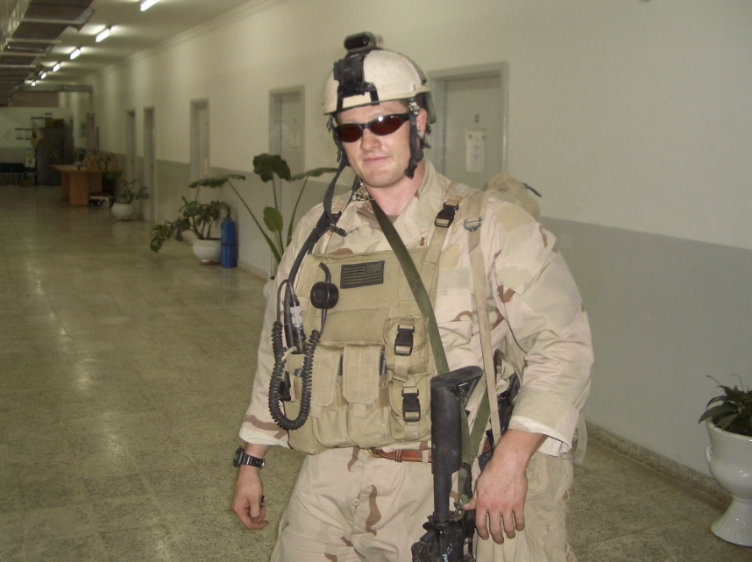
Stephan Drum is a retired Navy SEAL Master Chief who served for 27 years while developing and leading high-performance teams.
Now living in Lake Bluff, Drum is a highly regarded keynote speaker. Drum works with individuals, organizations, and businesses to strengthen leadership skills, helping them prepare and perform effectively.
Drum always knew that he wanted to serve: He always felt patriotic and wanted to do something special. He planned on joining the Army to be a Green Beret, but he had an uncle who was a Navy Veteran who nudged him towards joining the Navy.
“I also remember reading a book about Navy SEALs in Vietnam, and I’m like, ‘Well, I’ll just try that.’ So, right out of high school, I decided I was going to join the Navy,” said Drum.
Drum joined the Navy with the intention of becoming a SEAL. Surprisingly enough, one of the toughest obstacles Drum faced in his first moments in the Navy was his math skills.
“I am really bad at math, so I missed the qualification by a few points. So, I spent my first couple of years working on nuclear submarines in Groton, Connecticut, at a shore facility. I didn’t get to go out on the submarines: I had to do jobs as a plumber on them,” said Drum.
After working on the submarines, he retook the math test and went through SEAL training, making it through his first try.
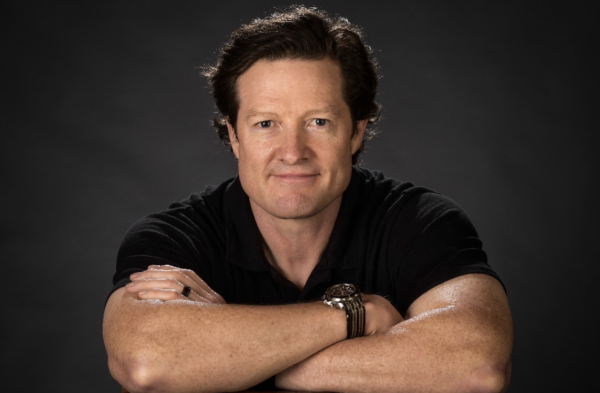
The toughest challenge for Drum and most SEALs was the initial six months of training. Basic Underwater Demolition/SEAL training or BUD/S is a grueling program testing physicality, mental strength, and teamwork. According to Drum, this is where the biggest attrition rate is in the Navy: 75-90% attrition.
“Six months is a really long time to go through that level of training. Hell week was hard: the cold, trying to meet the timed runs, swims, and obstacle courses. I think in my head I built it up to be this big kind of mythical beast, and so I had confidence issues because I thought of it as such a massive challenge. But at the end of the day, it was never quite as difficult as I had built it up to be in my mind,” said Drum. “Honestly, the closest I came to failing out was again a math test. You had to do dive physics in the second phase of training, and I failed that test and had to retake it. Luckily, I passed the second time.”
Only a small portion of candidates who begin the Navy SEAL process successfully become SEALs. Drum believes what separates those who make it and those who don’t is the level of commitment.
“You have higher success rates for different athletic communities, [such as] wrestlers and water polo players. You have to get there, be in excellent physical condition, and be comfortable in the water. But, I think what it ultimately comes down to is a supreme level of commitment. You have to be able to perform under pressure. You have to want it more than anything else and be willing to pay the price in terms of the pain and suffering to make it through,” said Drum.
Drum explains that his ability to detach was one of the biggest advantages he had over other Sailors.
“A lot of people get overwhelmed by the enormity of situations. If you’re about to leave for college, for example, you don’t have to immediately worry about the next four years. Think about what is coming today: think about how I can make it through today and be ready and prepared for what is tomorrow? Next thing you know, it’ll be Saturday. And when you do that, and you gain momentum and confidence, you get stronger and more resilient,” said Drum.
Looking back on 27 years of service, Drum has many accomplishments, but one sticks out the most.
“I got time in combat and leading in combat, which was all great, but if I look back and say what my most significant impact was in my career, it was probably training other people. I developed leaders under me and ran training for Sailors to get ready for combat. The last thing I was involved with was being a co-creator of a program to make all Navy Sailors tougher and ready for combat using sports psychology, mindfulness, character development, and methods to prepare and execute for combat operations,” said Drum.
This program impacted Drum’s work substantially. Drum later translated this Sailor program into content applicable to businesses.
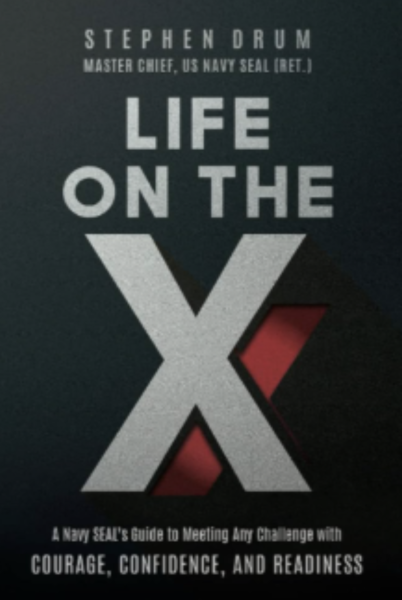
In 2023, Drum’s book Life on the X was published. In the military, the X is a doctrine term.
“Think of it as X marks the spot. When we say X marks the spot, or we’re gonna land on the X, it means the center point of the attack,” said Drum. “There’s also a dual usage for that. For example, if we’re in a group patrolling down a city street, and we get to the street corner, and there’s an ambush and all enemy fire is converging on that corner, we call that the X as well.”
For Drum’s book, he uses these pivotal moments and situations on the X and applies them to regular civilian life.
“We use that X as an example of the most difficult, dangerous, and challenging situations in business, personal lives, or school as something to prepare for. If you’re in sales, an X would be when you stand in front of a customer, or you’re delivering a presentation, it’s like ‘I gotta go out and be under pressure, I have to perform.’ And as parents, it’s when we’ve had a really tough day and a really stressful week and now we have to switch gears and make sure [that] when we walk through the door we’re not complete jerks to our family,” said Drum.
Drum explains that he is trying to get people to look at moments in their lives–professionally or personally–that really matter and to prepare well for them.
“We have to think about how we impact others; how we drive success; what it is going to take for me to show up fully prepared, confident, poised, and focused, and be able to deal with curveballs that we face and not get knocked out of the saddle or get thrown off our game. Because we have put the work in. What I want people to do is to say ‘hey, take a step back, look ahead and say what challenge am I going to face tomorrow and what is it going to take for me to be ready for that,’” said Drum.
It is never a seamless and easy transition from the military to the civilian world. For Drum, he had to try to find a purpose that was no longer provided for him by the military.
“I think a lot of veterans struggle with transition because you have a structure and a framework and a reason for everything you do in the military. The military gives you that sense of purpose, just like a professional athlete who wants to win for their team. All of a sudden, when you’re left without those things, you have to reinvent yourself and find purpose in something new,” said Drum.
However, it wasn’t the search for purpose that led Drum to want to write a book. Drum has always been intrigued in speaking of his experiences and advice.
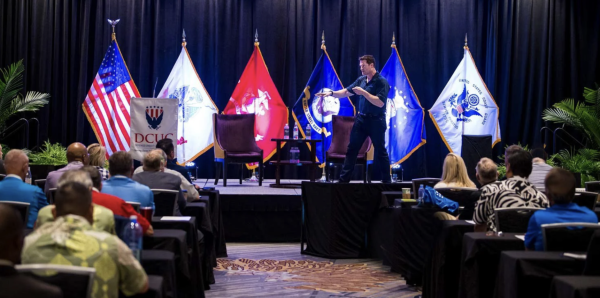
“There’s a whole running joke about how every Navy SEAL writes a book, and I was like, ‘I don’t want to be that guy too,’ so I was reluctant about writing a book. But, I already planned on being a speaker because I felt like my greatest impact was my teaching,” said Drum. “During COVID, when I couldn’t speak in person, I thought maybe I do need to take this time to write a book. I got more emotionally invested in the process and thought what I was writing was worth sharing with other people and organizations.”
The message Drum wants to convey from his book and speeches is that he wishes people would be more deliberate and intentional.
“People can underestimate the potential value of showing up prepared. When you go into a stressful situation and carry with you a confidence that is based on the belief of your training and preparation, then it causes you to raise your game. I don’t want people to take for granted opportunities, great and small, that really move the needle in your life. I want people to understand what it takes to fully prepare, and here is how you can be your best self when you have a level of fear and stress and still show up as the best version of yourself,” said Drum.
Drum uses a four-part interactive cycle to guide his life.
“Commit, prepare, execute, and reflect. You are committing–meaning you have decided you are trying to do something of consequence. You give yourself, or you give those that you lead certain guidance, you come up with a plan, and then you prepare for that objective. And then you execute on that objective. When you are finished, you assess, and you reflect. Ask yourself ‘How did I do? What was the architecture that led to the result, good or bad? What contributed to the result that I got? Based on that experience, how do I utilize what I learned for my next plan?” said Drum.
Building discipline as a high schooler or young adult can be challenging. Drum believes the key to discipline for young students is putting a plan together with the end goal always in mind.
“Visualize what winning that objective looks like. Create a picture in your mind and then build backwards, thinking about what skills, learning, and resources will contribute to getting to that end result. But also, understand that you are going to fail along the way. Fail fast and get back up on the horse. If you are going to change the path, determine ahead of time what constitutes a reason to change your mind. If I am going to change my career path, it has to be because of real reasons–not because I don’t want to do something anymore. Train your mind like you train your body,” said Drum.
In order to handle setbacks, one has to be comfortable going out of one’s comfort zone, according to Drum.
“Handling setbacks is about being willing to admit the hard truth and asking others for feedback, even if it isn’t what we want to hear. But there is always value in our experiences. You just can’t let your emotions get in the way of getting that value for yourself. We can quit and let it cripple us, or we can use it in a way to develop ourselves,” said Drum.
With all of Drum’s experience, his advice to his younger self is simple and something all students can try to implement in their lives.
“Be able to separate the emotion from what actually happened and take time to really reflect more deeply on the lessons you had,” said Drum.